Architecture
KOLONİ is one Python process that serves a React page and an HTTP API on 127.0.0.1, keeps its data in
SQLite, and runs agents as asyncio tasks.
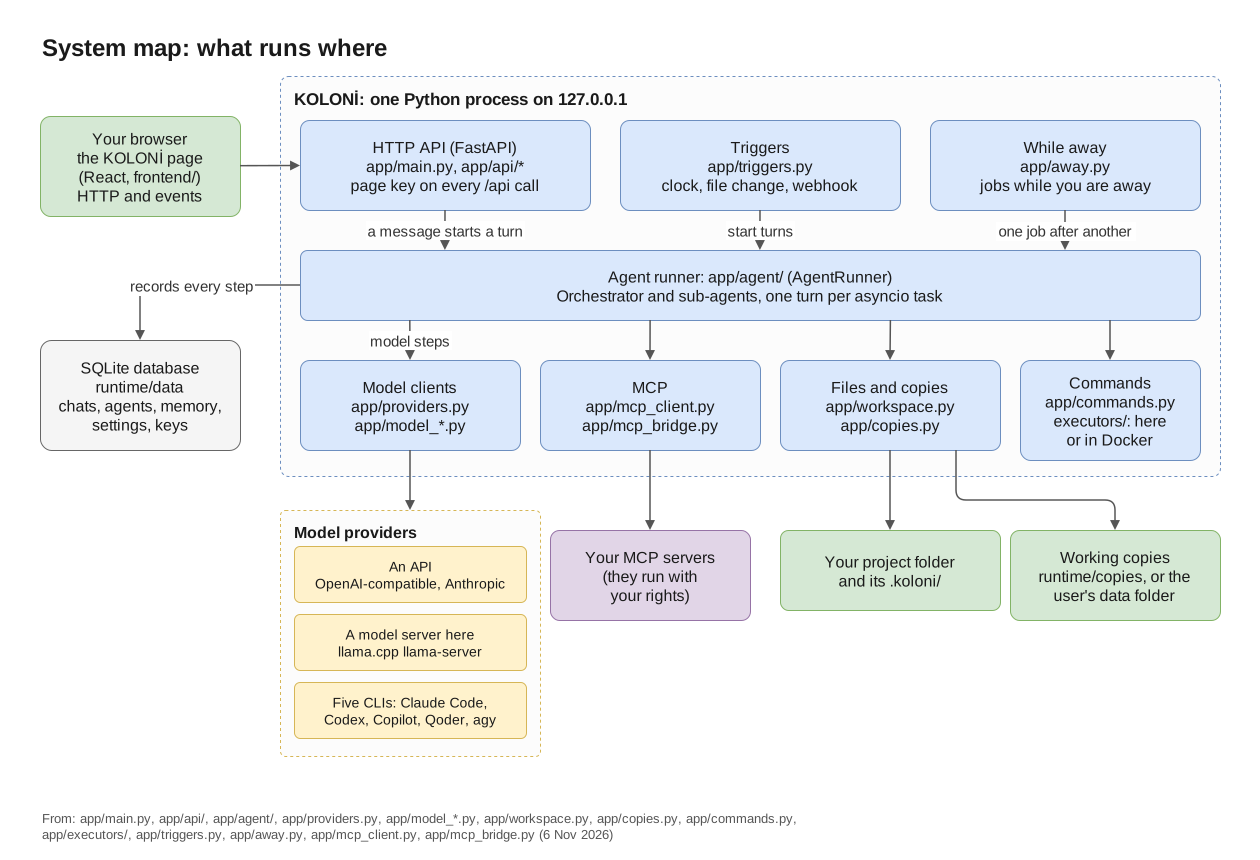
What runs where. The diagrams' sources are in docs/diagrams/, with a README on editing them.
Backend (app/)
main.pybuilds the app. At the start it applies a staged restore, backs up and migrates the database, tidies it, marks work that was cut off as interrupted, seeds the built-in roles and the first providers, and sets the page key. It serves the built page fromfrontend/diston the same origin. FastAPI's own docs pages are switched off.api/: the HTTP routes, all under/api.agent/: the agent runner.AgentRunnerruns one turn per asyncio task. It is split into mixins (spawning sub-agents, cards and approvals, memory, limits, rooms, discussions, work while you're away and more); the package docstring lists them.- Model clients:
model_client.py(OpenAI-compatible),model_anthropic.py(the Anthropic Messages API),model_cli.py(a CLI as one step per model step),model_session.py(a CLI session whose only tools are KOLONİ's, over MCP),model_native.py(a CLI with its own tools),model_agy.py(agy).providers.pychooses which one runs a role. db/andalembic/: SQLAlchemy models and migrations. The database is backed up before a migration.workspace.py: file access confined to the project folder and the folders the user opens.copies.py: each sub-agent works in its own copy, outside the project; its changes come back by a three-way merge.commands.py,command_runner.py,executors/: which commands ask, and running them on this machine or in Docker.triggers.py: clock, file-change and webhook turns.mcp_client.py: the client for the user's MCP servers.mcp_bridge.py: the small program a CLI starts as its MCP server, which relays to KOLONİ's own tools.
Frontend (frontend/)
React, Vite, React Flow (the canvas) and Zustand (the store, src/state/store.ts).
src/api/generated.ts holds the API's types, generated from the backend's schema by
scripts/export_openapi.py; after changing an API shape, run npm run generate:api in frontend/.
How the page talks to the API
Every /api request carries the page key in the X-KOLONI-Key header (or ?key= for event streams and
downloads). The page takes the key from the link KOLONİ prints, or swaps a one-time code for it, and keeps
it in the browser's local storage. A few doors need no key: the health check, webhooks, Claude Code's
status line, and the one-time code exchange.
Events reach the page over server-sent events, per conversation.
How a turn flows
- The page posts a message to the conversation.
- The server records it and starts a run as an asyncio task.
- The Orchestrator (the Lead role) works with its tools and may open sub-agents, each in a working copy.
- Anything that needs the user becomes a card; the run waits for the answer.
- A finished sub-agent's changes are taken into the project, or put before the user on a card first.
- Every step is recorded, and the canvas draws the turn from that record.
The same turn, step by step: where it waits for you, and how the page hears of each step.
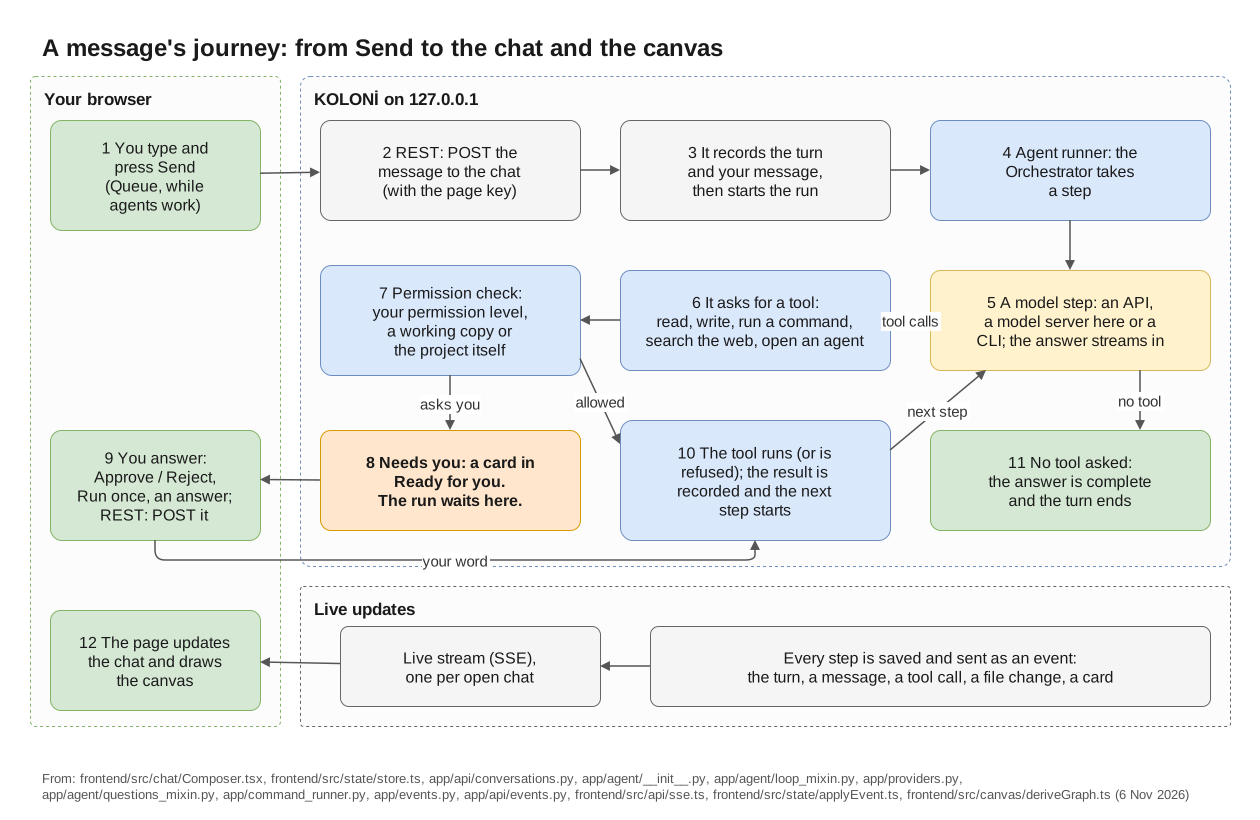
A message's journey, from Send to the chat and the canvas. (full size)
The data model
The database is SQLite, its tables in app/db/models.py. A project has chats; a chat has turns (runs);
a turn has agents, and an agent has messages, tool calls, file changes, commands and take-ins (merges).
Memory, knowledge, to-do tasks and triggers belong to a project; providers, roles, teams and recipes are
the same for every project. Working copies are folders, not rows.
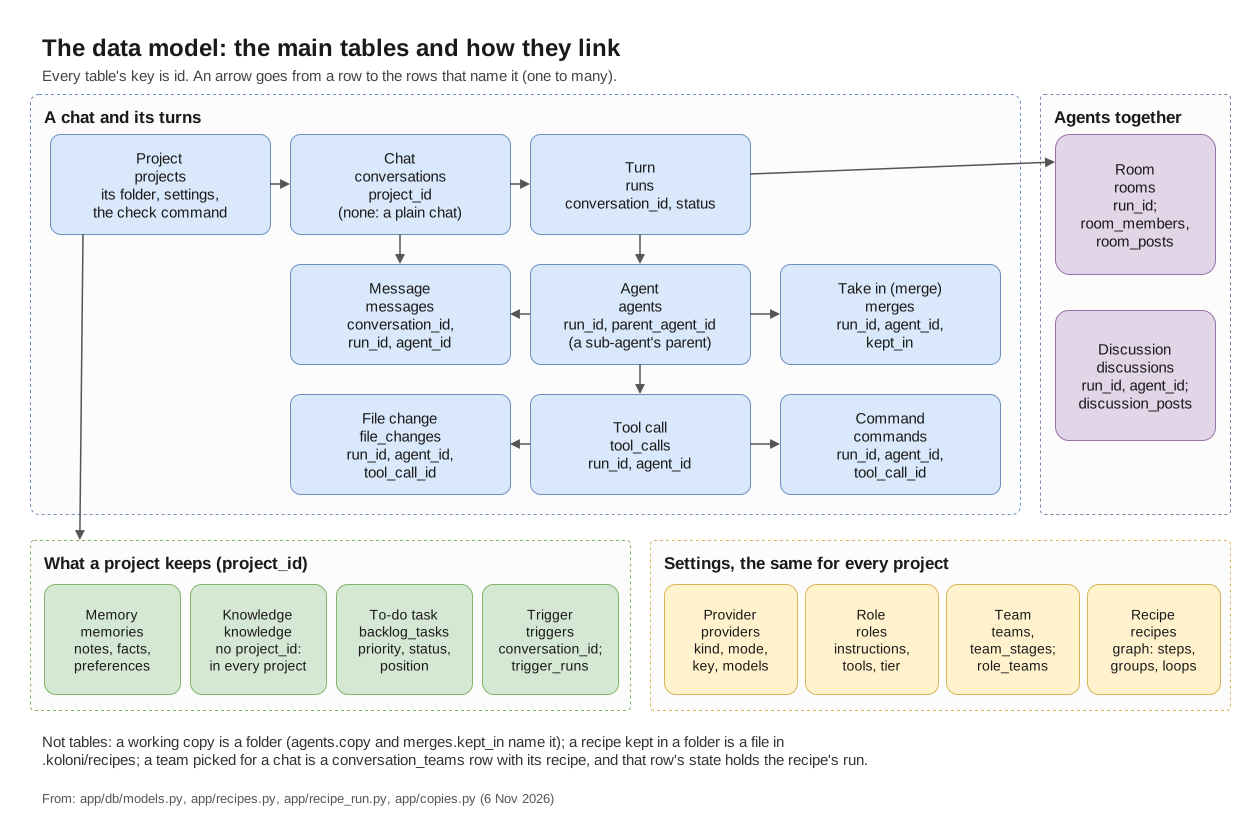
The main tables, their keys and how they link. (full size)
Inside the agent runner
app/agent/ holds AgentRunner, built from mixins, one per part. A turn picks its model by tier, then
loops: in step mode KOLONİ builds the history (compacting it when it is too long), asks the model, and
runs each tool call it asks for. A CLI in session or native mode keeps the loop itself. Limits, slots,
observing, recording and the rest work around every step.
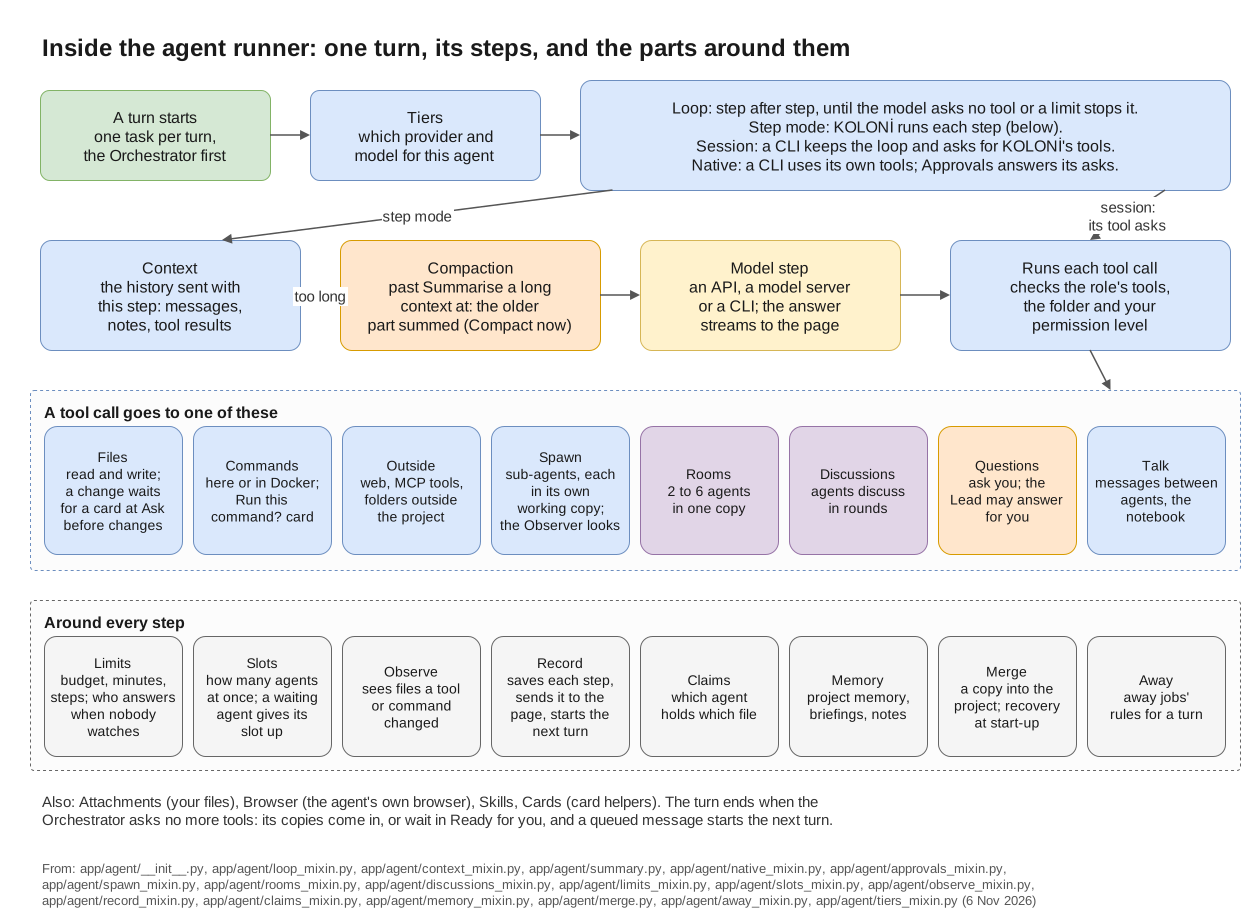
The agent runner's parts and how a step flows through them. (full size)